
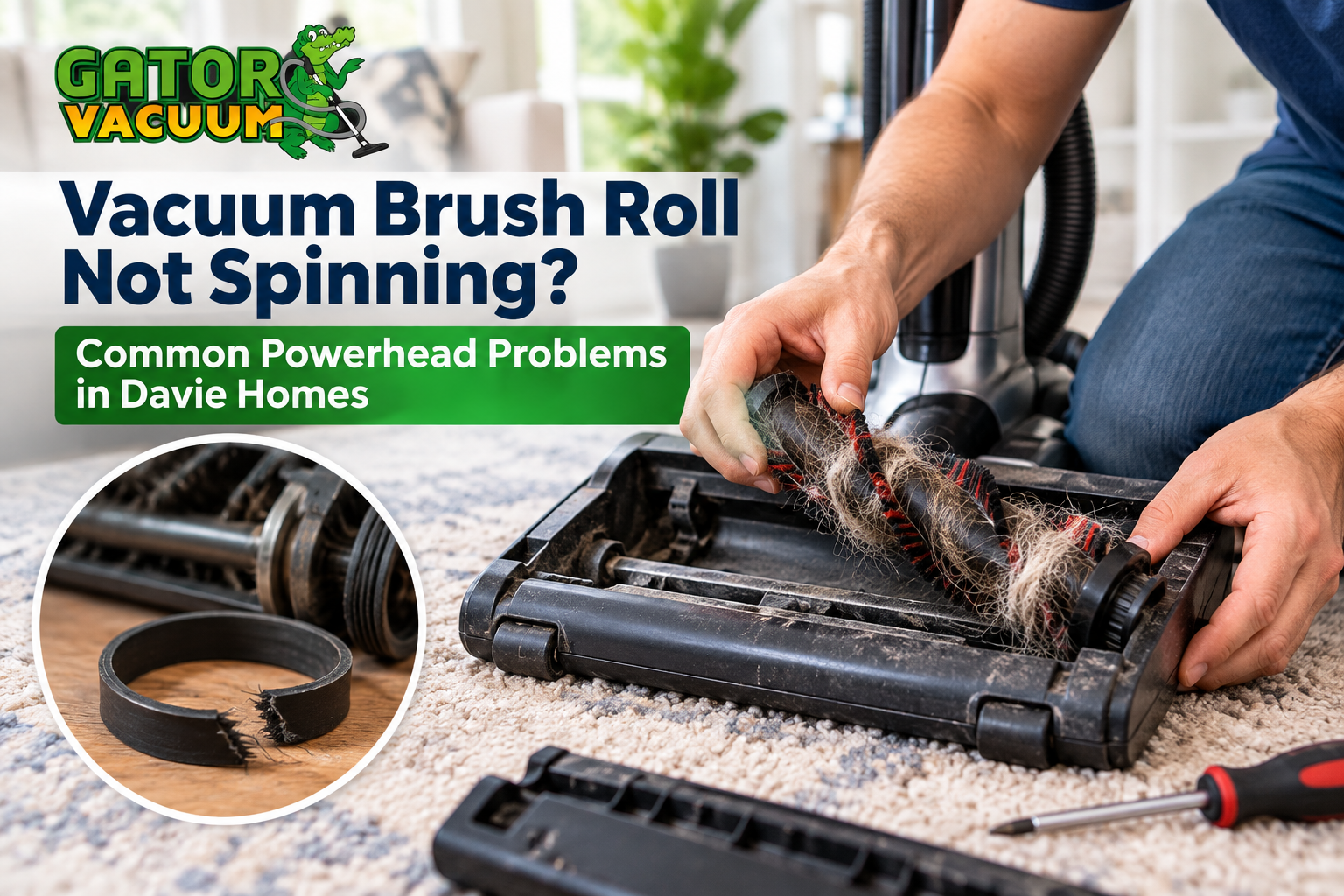
Vacuum Brush Roll Not Spinning? Common Powerhead Problems in Davie Homes
If your vacuum still has strong suction but your carpet suddenly is not getting clean, the problem may not be the vacuum motor or central vacuum system at all. In many cases, the real culprit is the powerhead brush roll.
A vacuum powerhead is designed to do more than simply move across the floor. The rotating brush roll, powered by a separate motor or belt system depending on the powerhead design, agitates carpet fibers and helps loosen dirt, pet hair, dust, and debris so the vacuum can remove it more effectively.
When the vacuum brush roll stops spinning, your vacuum may continue to run and still have excellent suction. However, cleaning performance can drop dramatically, especially on carpet.
For homeowners in Davie, Florida, understanding the most common powerhead problems can help you determine whether your vacuum needs a simple cleaning, a replacement part, or professional vacuum repair.
At Gator Vacuum & Sewing, we help homeowners troubleshoot and repair vacuum cleaners, central vacuum accessories, powerheads, hoses, and related components. If your powerhead has stopped working properly, the issue may be easier to fix than you think.
What Does the Brush Roll Do?
The brush roll is one of the most important components inside a powered vacuum head.
As you push the powerhead across carpet, the brush roll spins rapidly. Bristles, agitators, or brush strips work their way through the carpet fibers to loosen debris. The vacuum’s suction then carries that loosened debris through the airflow system.
This combination of agitation and suction is especially important for:
• Carpeted bedrooms
• Living rooms
• Area rugs
• Pet hair
• Ground-in dirt
• Fine debris trapped between carpet fibers
• High-traffic areas
When the brush roll stops spinning, the vacuum may sound like it is operating normally. You may even notice that the suction at the hose is still strong.
But if the brush roll is not rotating, the powerhead is not doing its part.
That is why one of the most common complaints we hear is:
“My vacuum has suction, but it isn’t picking up the dirt like it used to.”
In many cases, the powerhead is the first place to investigate.
1. Hair and Debris Wrapped Around the Brush Roll
One of the simplest—and most common—reasons a brush roll stops spinning is hair buildup.
Long hair, pet hair, thread, string, carpet fibers, and other debris can become tightly wrapped around the ends of the brush roll. Over time, the buildup can create enough resistance to slow the brush roll or stop it completely.
This is particularly common in homes with:
• Dogs
• Cats
• Long-haired family members
• Multiple pets
• High-pile carpeting
Hair may also wrap around the brush-roll bearings or end caps rather than simply collecting in the middle of the brush.
If the brush roll is difficult to turn by hand when the powerhead is disconnected from the vacuum, debris may be preventing it from moving properly.
Regularly checking and cleaning the brush roll can help prevent unnecessary wear.
However, if the brush roll has already become damaged or the bearings have seized, cleaning alone may not solve the problem.
2. A Stretched or Broken Powerhead Belt
Some powered vacuum heads use a belt to transfer power from the motor to the brush roll.
Over time, belts can stretch, crack, become brittle, or break.
A stretched belt may allow the brush roll to turn, but not at the proper speed. In other cases, the brush roll may start spinning and then stop when it encounters resistance from carpet.
A completely broken belt will usually result in a brush roll that does not move at all.
You may hear the powerhead motor running while the brush remains stationary.
That is a classic indication that the powerhead belt may be broken, stretched, or slipping.
Replacing the belt can sometimes restore the powerhead to proper operation. However, it is important to use the correct belt for the specific powerhead. Installing the wrong belt can result in poor performance or premature failure.
3. Worn Brush Roll Bearings
The brush roll needs to rotate smoothly.
At each end of the brush roll are components that allow it to rotate. Depending on the design, these may include bearings, bushings, end caps, or other supports.
Over time, these components can wear out.
When a brush-roll bearing begins to fail, you may notice:
• A grinding sound
• A squealing noise
• Increased vibration
• A brush roll that turns unevenly
• The brush roll becoming difficult to turn
• The powerhead shutting down when the brush encounters carpet
A worn bearing can also put additional stress on the belt and powerhead motor.
If you continue using the powerhead while the brush roll is binding, you may turn what could have been a relatively simple repair into a larger problem.
4. Electrical Connection Problems
Powered vacuum heads require electricity to operate the brush-roll motor.
Depending on your vacuum system, power may travel through the hose, wand, electrical contacts, wiring, or connections inside the powerhead.
A poor electrical connection can cause intermittent operation.
For example, your powerhead may:
• Work sometimes and stop other times
• Start when the handle is moved into a certain position
• Stop when the hose or wand moves
• Have no brush-roll motor activity
• Work briefly and then shut off
Dirty, worn, loose, or damaged electrical contacts can interfere with the flow of electricity.
This is one reason it is important not to immediately assume that a failed brush roll means the entire powerhead needs to be replaced.
The problem could be an electrical connection, switch, wiring issue, or another replaceable component.
5. A Failed Powerhead Switch
Many powered vacuum heads have a switch that controls the brush-roll motor.
A worn switch can eventually fail due to repeated use.
If the switch no longer makes reliable electrical contact, the brush roll may not turn even though the vacuum itself continues to operate.
A switch problem may be more likely if the powerhead has been used frequently for many years.
You may notice that the powerhead works intermittently or that the brush roll starts and stops unexpectedly.
Before replacing the entire powerhead, it can be worthwhile to have the switch and electrical circuit inspected.
6. Powerhead Motor Problems
The brush roll is typically driven by a motor inside the powerhead.
Like any electric motor, it can eventually wear out.
A failing powerhead motor may produce unusual noises, become excessively hot, operate intermittently, or fail to run at all.
Motor problems can sometimes be caused by excessive resistance from a jammed brush roll. If hair and debris prevent the brush from rotating, the motor may have to work much harder than it was designed to.
Over time, this additional load can contribute to motor wear.
If the brush roll is clean, the belt is intact, the electrical connections appear normal, and the switch is functioning, the motor may need further testing.
Depending on the powerhead, replacing the motor or another internal component may be possible.
7. The Brush Roll Itself May Be Worn Out
Sometimes the problem isn’t that the brush roll has stopped spinning.
Instead, the brush roll may be spinning but no longer cleaning effectively.
Brush strips and bristles wear down over time. The brush roll can also become damaged, bent, cracked, or worn at the ends.
When the bristles become significantly worn, they may no longer agitate carpet effectively.
This can be especially noticeable in homes with heavy carpet traffic.
You may find that:
• The brush roll spins but doesn’t pick up embedded debris
• Carpet doesn’t look as clean after vacuuming
• Pet hair remains behind
• The vacuum needs multiple passes over the same area
• The brush roll appears visibly worn
Replacing a worn brush roll may restore the cleaning performance of the powerhead without requiring replacement of the entire unit.
8. The Powerhead May Be Clogged
While most people think about clogs inside the vacuum hose, the powerhead itself can also become obstructed.
Debris can accumulate around the brush roll, intake opening, belt area, or other internal passages.
A clog can restrict airflow and increase the load on the brush-roll system.
If your powerhead suddenly becomes louder, stops spinning, or begins overheating, inspect it for visible obstructions.
Always disconnect the powerhead from the vacuum system before attempting to remove debris or inspect moving components.
How to Tell What Is Wrong With Your Powerhead
If your vacuum brush roll is not spinning, start with a few basic observations.
Check #1: Is the vacuum itself running?
If the vacuum motor is running and you still have suction, the issue may be isolated to the powerhead.
Check #2: Is the brush roll completely stationary?
If the powerhead motor is running but the brush roll isn’t moving, a belt or mechanical problem may be responsible.
Check #3: Does the brush roll turn freely?
With the powerhead disconnected, carefully check whether the brush roll can rotate normally.
If it is difficult to turn, look for wrapped hair, debris, or possible bearing problems.
Check #4: Do you hear unusual noises?
Grinding, squealing, clicking, or burning smells can indicate a mechanical or electrical problem.
Check #5: Does the powerhead work intermittently?
Intermittent operation can point toward a switch, electrical connection, wiring, or motor problem.
Should You Replace the Powerhead or Repair It?
This is a common question from homeowners.
The answer depends on the condition and design of the powerhead.
If the powerhead housing, motor, and major components are in good condition, replacing a belt, brush roll, switch, bearing, or other individual component may be a practical repair.
However, if multiple components have failed or the powerhead is severely worn, replacement may make more sense.
A professional inspection can help determine which option provides the best value.
At Gator Vacuum & Sewing, we can help you identify the source of the problem and determine whether you need a vacuum powerhead repair, replacement brush roll, belt, electrical component, or complete powerhead replacement.
Don’t Ignore a Powerhead That Has Stopped Spinning
It can be tempting to continue using a vacuum when the brush roll stops working because the vacuum still has suction.
But suction alone does not provide the same carpet-cleaning action as a properly functioning powered brush roll.
A powerhead that is struggling to turn can also place additional stress on its belt, motor, bearings, and other components.
Addressing the problem early may help prevent additional damage.
For Davie homeowners, getting the right replacement part can also be important. Vacuum powerheads are not universal, and different models can use different brush rolls, belts, motors, electrical connections, and switches.
That is why identifying the exact powerhead and vacuum model is an important part of the repair process.
Professional Vacuum Powerhead Repair in Davie
When your vacuum brush roll is not spinning, don’t assume that your entire vacuum cleaner has failed.
The problem may be as simple as tangled hair or a broken belt. It could also involve worn bearings, a faulty switch, electrical connections, a damaged brush roll, or a failing powerhead motor.
The good news is that many powerhead problems can be diagnosed and repaired without replacing the entire vacuum system.
Gator Vacuum & Sewing serves homeowners looking for help with vacuum repair, central vacuum accessories, powerheads, replacement parts, and related vacuum problems in Davie and surrounding South Florida communities.
If your vacuum still has suction but your carpets aren’t getting clean, the brush roll and powerhead should be one of the first places to look.
Whether you need a replacement brush roll, belt, powerhead component, or professional troubleshooting, getting the problem diagnosed correctly can help restore your vacuum’s cleaning performance and extend the life of your equipment.
Is your vacuum brush roll not spinning? Bring your powerhead or vacuum to Gator Vacuum & Sewing for help identifying the problem and finding the right repair or replacement solution.
If your vacuum has strong suction but the brush roll still is not spinning, the issue may be inside the powerhead rather than the main vacuum motor. Gator Vacuum & Sewing provides professional vacuum repair services for problems involving belts, brush rolls, motors, switches, and electrical connections.
A powerhead that stops spinning, works intermittently, or makes unusual noises can sometimes be repaired without replacing the entire vacuum. Our vacuum repair in Davie service can help identify whether the problem is caused by hair buildup, a worn belt, damaged bearings, or another component.
If basic cleaning does not restore the brush roll, it may be time for a professional inspection. Visit our vacuum repair service page to learn more about troubleshooting and repair options for vacuum cleaners, powerheads, and related components.