

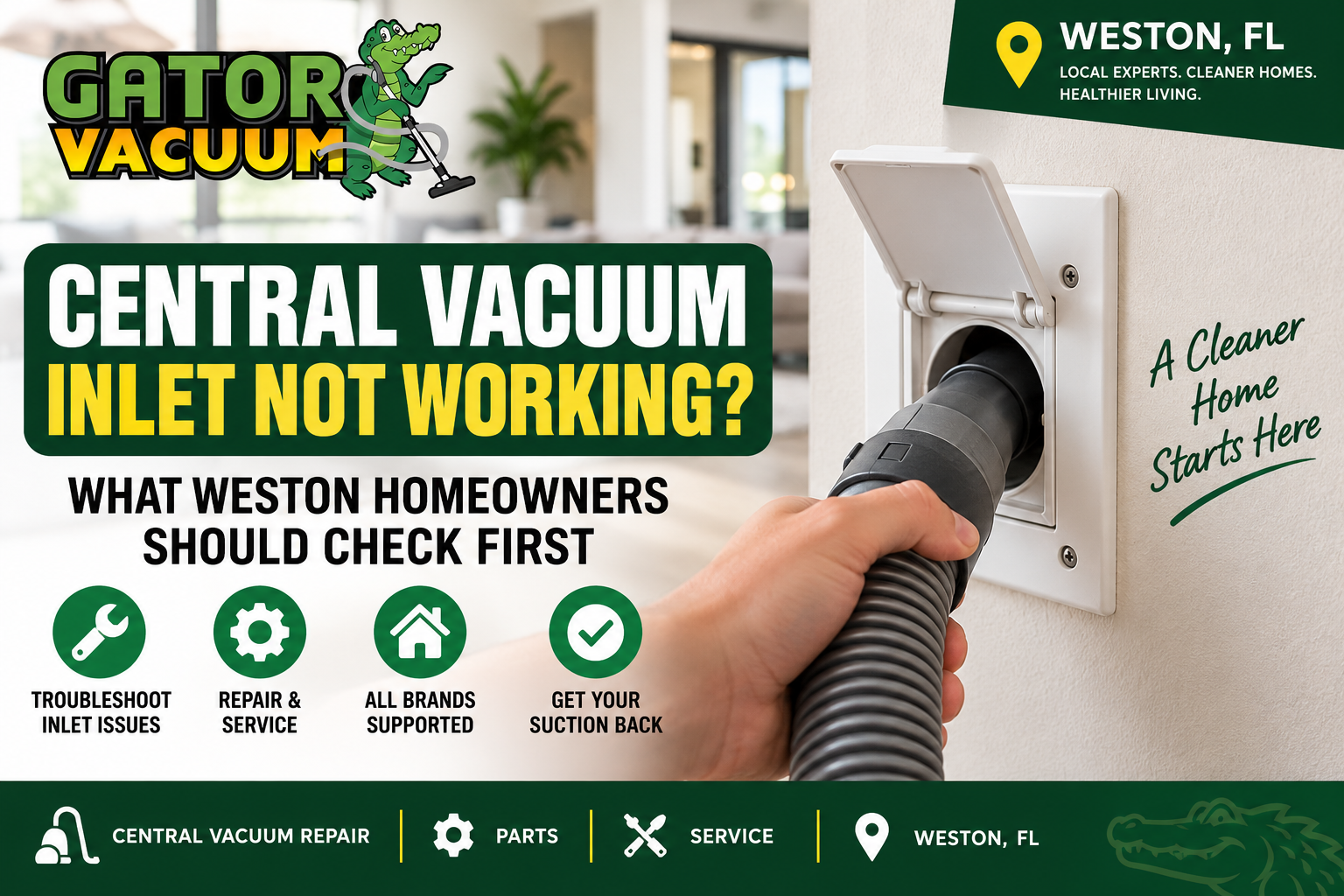
Central Vacuum Inlet Not Working? What Weston Homeowners Should Check First
A central vacuum system can make cleaning your home much easier—until you plug the hose into a wall inlet and nothing happens.
One of the most common situations homeowners experience is having several central vacuum inlets that work normally while one inlet appears completely dead. When this happens, the central vacuum power unit itself may still be working properly.
If one central vacuum inlet is not working while the others are, the problem is often isolated to the wall inlet, low-voltage wiring, hose connection, electrical contacts, or the section of tubing serving that area of the home.
For homeowners in Weston, Florida, there are several things you can check before assuming the entire central vacuum system needs to be replaced.
Why Is My Central Vacuum Inlet Not Working?
Central vacuum systems typically use several wall inlets connected through PVC tubing to a main central vacuum power unit.
Many systems also use low-voltage wiring that tells the central vacuum motor when the hose has been connected.
Because several components work together, a problem with one wall inlet does not automatically mean that your central vacuum motor has failed.
Common causes of a central vacuum inlet not working include:
- Loose low-voltage wiring
- Damaged inlet valves
- Worn electrical contacts
- Poor hose connections
- Localized tubing clogs
- Air leaks
- Faulty inlet switches
- Damaged tubing
- Loose fittings
- Debris around the inlet door
The first step is determining whether the issue affects one inlet or the entire system.
Central Vacuum Inlet Not Working but Others Work
If several wall inlets work correctly but one does not, that is an important troubleshooting clue.
Test your central vacuum hose at several outlets around your home.
For example, if you have six central vacuum inlets and five work normally while one bedroom inlet does nothing, the main vacuum unit is probably capable of operating.
That means you should concentrate on the individual inlet, wiring, hose connection, or nearby tubing instead of immediately replacing the central vacuum power unit.
Check the Central Vacuum Hose Connection
Sometimes the wall inlet isn’t actually the problem.
The hose may not be making proper contact with the electrical or low-voltage connections inside the inlet.
Remove the hose and carefully reconnect it.
Make sure it is inserted completely.
Then test the same hose at another wall inlet.
If the hose works perfectly at another location but doesn’t activate the system at one specific inlet, the problem is more likely related to that particular inlet or its wiring.
If you have another compatible hose available, testing it can help eliminate the hose itself as the cause.
Check for a Damaged Central Vacuum Wall Inlet
Central vacuum inlet valves receive years of repeated use.
Over time, an inlet can become:
- Loose
- Cracked
- Worn
- Damaged
- Misaligned
A damaged central vacuum inlet may cause symptoms such as:
- Vacuum does not start
- Hose does not stay connected
- Inlet door does not close properly
- Weak suction
- Intermittent operation
- Loose wall plate
- Visible physical damage
Fortunately, a defective wall inlet often can be replaced without replacing the entire central vacuum system.
Check the Low-Voltage Wiring Behind the Inlet
A common reason a central vacuum wall inlet fails to activate the motor is a problem with the low-voltage control wiring.
The wiring tells the central vacuum power unit when the hose has been connected.
If the wiring behind one inlet becomes loose, damaged, or disconnected, the motor may never receive the signal to turn on.
Possible causes include:
- Loose wiring connections
- Aging wiring
- Previous remodeling
- Movement of the inlet
- Improper installation
- Damaged electrical contacts
- Corrosion
If you’re comfortable inspecting the inlet, you may be able to identify an obvious disconnected wire.
More complicated electrical troubleshooting should be handled by someone familiar with central vacuum control circuits.
Can One Central Vacuum Inlet Be Clogged?
Yes.
A central vacuum clog does not always affect every inlet in the home.
If one inlet has very weak suction while other outlets have strong suction, there may be a blockage in the branch of tubing connected to that inlet.
Common objects that can clog central vacuum tubing include:
- Paper
- Small toys
- Socks
- Hair
- Large debris
- Household objects accidentally vacuumed up
A localized clog becomes especially likely when the problem appeared suddenly and only affects one area of the house.
Central Vacuum Turns On but Has Weak Suction at One Inlet
If the central vacuum motor turns on but one inlet has considerably less suction than the others, the activation circuit may be working correctly.
Instead, investigate airflow problems.
Possible causes include:
- Clogged hose
- Blocked wall inlet
- Tubing obstruction
- Air leak
- Cracked fitting
- Damaged pipe
- Loose connection
- Worn inlet gasket
Compare the suction from the affected outlet with another working outlet.
A noticeable difference can help distinguish an airflow problem from an electrical activation problem.
Check for a Central Vacuum Air Leak
Central vacuum systems depend on sealed tubing to maintain proper airflow.
An air leak around an individual inlet or section of piping can significantly reduce suction.
Possible leak locations include:
- Wall inlet
- Inlet gasket
- Tubing connection
- PVC fitting
- Hidden tubing inside the wall
You may hear a hissing sound near the inlet when the central vacuum is running.
Because much of the tubing is hidden inside walls, professional diagnosis may be necessary when the leak cannot be easily located.
Central Vacuum Inlet Has Suction but Won’t Turn On
Another situation occurs when the airflow path appears clear but the vacuum does not activate when the hose is connected.
This can indicate a problem with the control circuit rather than the tubing.
Possible causes include:
- Low-voltage wiring failure
- Faulty inlet switch
- Damaged contacts
- Poor hose electrical connection
If your hose activates the system from other wall inlets, the problem is more likely associated with the problem inlet.
Why Does My Central Vacuum Inlet Work Intermittently?
Pay attention to what happens when you move or reconnect the hose.
If the vacuum:
- Starts and stops
- Works only when the hose is positioned a certain way
- Activates after repeatedly reconnecting the hose
you may have a loose electrical connection, worn contact, failing inlet switch, or hose connection problem.
These symptoms can be particularly useful when diagnosing the system.
Don’t Automatically Replace the Central Vacuum Motor
A non-working wall inlet does not automatically mean the central vacuum power unit has failed.
If several other outlets still operate normally, the power unit should generally not be the first component you suspect.
Instead, investigate the affected wall inlet and its associated wiring and tubing first.
Correctly identifying the source of the problem may prevent unnecessary replacement of an expensive central vacuum power unit.
Repair or Replace a Central Vacuum Inlet?
A defective central vacuum inlet does not normally mean the entire system needs to be replaced.
Depending on the problem, the repair may involve:
- Replacement inlet valve
- Low-voltage wiring repair
- New electrical contacts
- Replacement inlet switch
- New gasket
- Tubing fitting
- Hose connection
- Replacement hose
The correct replacement component depends on the type and age of the central vacuum system.
Taking a photo of the existing inlet or identifying the manufacturer and model can make finding compatible replacement parts easier.
When Should You Call for Central Vacuum Repair?
Basic troubleshooting such as testing another outlet, reconnecting the hose, checking suction, and looking for obvious damage can often help narrow down the problem.
Professional diagnosis becomes more useful when:
- One inlet consistently fails
- Several outlets suddenly stop working
- The inlet works intermittently
- One outlet has much weaker suction
- You suspect a hidden pipe clog
- Low-voltage wiring is damaged
- The wall inlet is physically broken
- You hear air leaking inside the wall
- Replacing or testing the hose does not solve the issue
Determining whether the problem is electrical, mechanical, or airflow-related can make the repair much more straightforward.
Central Vacuum Repair in Weston, FL
If you’ve completed the basic checks and your central vacuum inlet still isn’t working, professional diagnosis can help locate the problem without replacing components unnecessarily. Gator Vacuum & Sewing provides central vacuum repair in Weston, FL, including troubleshooting for wall inlets, low-voltage wiring, clogged tubing, hoses, suction problems, parts, and central vacuum power units.
A technician can determine whether the failure is located at the inlet itself, inside the control wiring, within the hose connection, or farther inside the tubing system. This is particularly helpful when the piping or electrical connections are hidden behind walls and cannot be inspected easily.
Need Central Vacuum Service or Repair in Weston?
A central vacuum system that works from some wall inlets but not others usually gives you an important clue: the problem may be localized rather than affecting the entire system.
Start by testing other inlets, checking your hose, comparing suction, and observing whether the motor activates.
If the problem continues, Gator Vacuum & Sewing offers Weston central vacuum service and repair for homeowners dealing with non-working inlets, weak suction, wiring problems, clogged pipes, damaged hoses, inlet replacement, and other built-in vacuum system issues.
Getting the specific problem diagnosed correctly can often be far more practical than replacing an entire central vacuum system.