
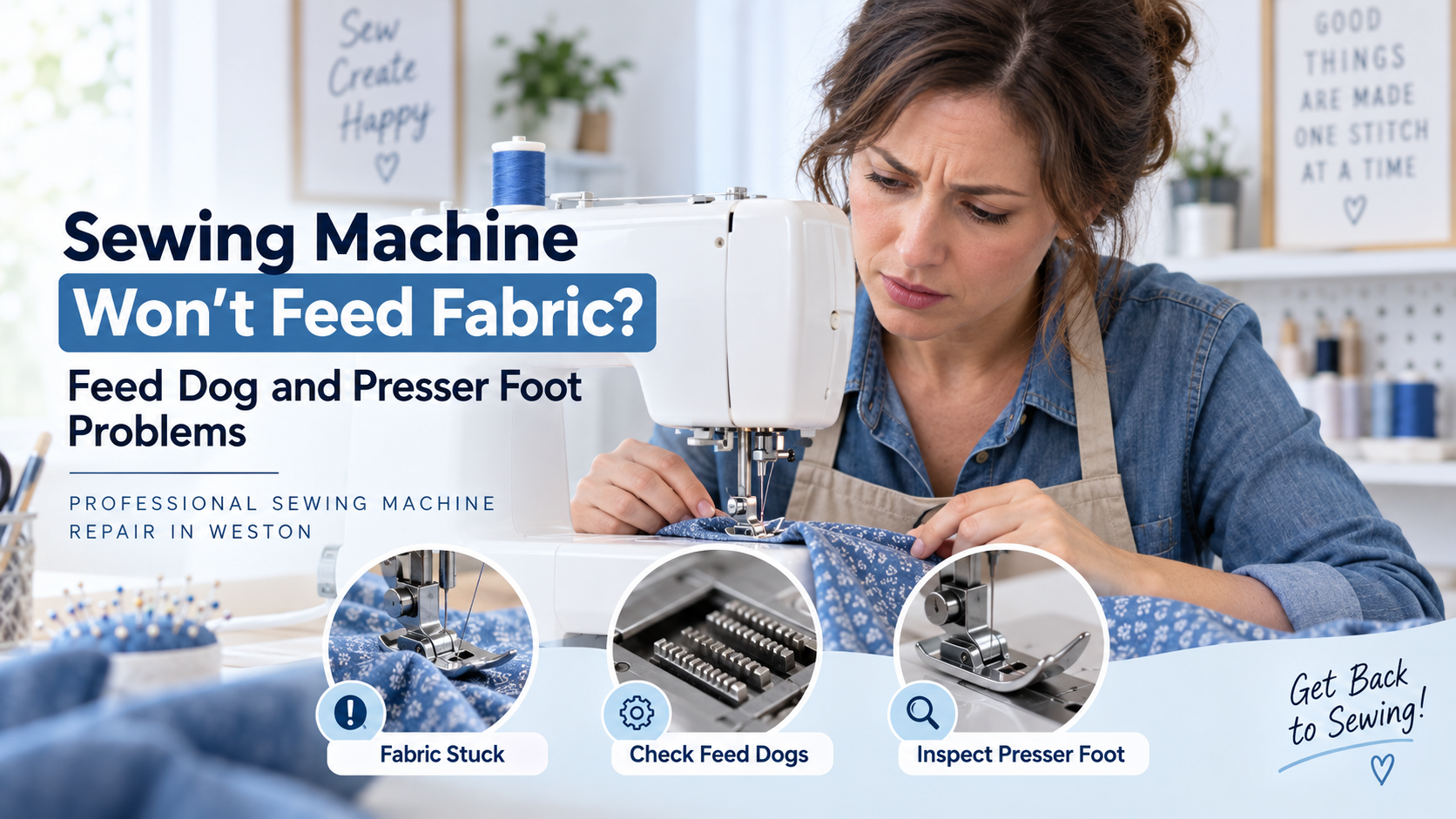
Sewing Machine Won’t Feed Fabric? Feed Dog and Presser Foot Problems in Weston
If your sewing machine turns on, the needle moves up and down, and the motor sounds like it is working—but your fabric barely moves or does not move at all—you may be dealing with a feed dog or presser foot problem.
This is a common sewing machine issue that can be frustrating because the machine may appear to be functioning normally. You can hear the motor running and see the needle stitching, but instead of smoothly pulling the fabric through, the fabric stays in place, bunches underneath the presser foot, or requires you to manually pull it along.
Fortunately, not every fabric-feeding problem means you need a major repair. Sometimes the cause is a simple stitch setting, lowered feed dogs, excessive lint, or incorrect presser-foot pressure. Other times, the problem can point to worn mechanical components, damaged gears, timing issues, or other internal problems that require professional sewing machine repair in Weston.
What Are Feed Dogs on a Sewing Machine?
The feed dogs are the small, textured metal teeth located underneath the presser foot and needle plate. Their job is to move the fabric forward as you sew.
During a normal stitch, the feed dogs move through a specific sequence:
1. They rise above the needle plate.
2. They grip the bottom of the fabric.
3. They move the fabric forward or backward.
4. They drop below the needle plate.
5. They return to their starting position.
This movement happens repeatedly as the machine stitches.
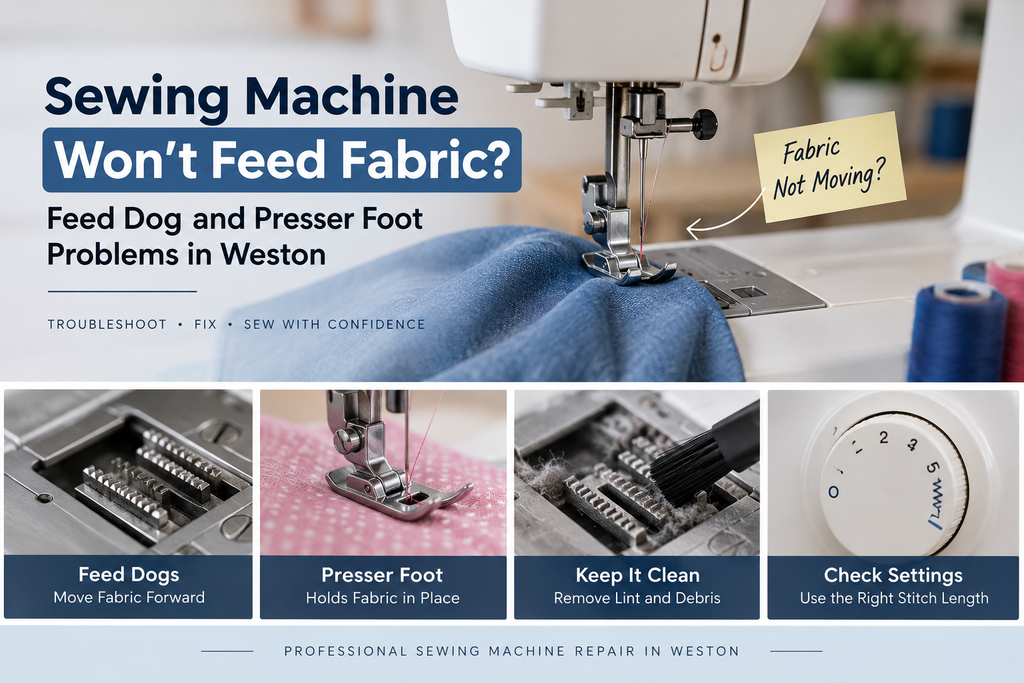
When the feed dogs are working correctly, you generally do not need to push or pull the fabric. The machine should move it at a consistent rate based on your stitch length.
When the feed dogs are lowered, blocked by lint, damaged, worn, or not moving correctly, the fabric may stop feeding.
Why Won’t My Sewing Machine Feed Fabric?
There are several possible reasons your sewing machine is running but the fabric is not moving. Before assuming that the machine needs an expensive repair, it is worth checking a few basic things.
1. The Feed Dogs May Be Lowered
One of the first things to check is whether your feed dogs have accidentally been lowered.
Many sewing machines have a feed-dog control used for free-motion sewing, quilting, darning, or embroidery. When the feed dogs are lowered, they no longer rise high enough to grip the fabric.
The result can be exactly what many homeowners describe as:
“My sewing machine works, but it won’t move the fabric.”
Check your machine for a feed-dog lever, switch, or button. Depending on the model, it may be located on the front, side, or rear of the machine.
If the feed dogs were intentionally lowered for free-motion sewing, return them to the normal sewing position.
Some machines also require you to turn the handwheel one or more times before the feed dogs return to their normal position.
2. The Feed Dogs May Be Dirty
Sewing produces an impressive amount of lint.
Fabric fibers, thread pieces, dust, and other debris can collect around the feed dogs and underneath the needle plate. Over time, this buildup can interfere with the feed dogs’ ability to move freely or grip the fabric.
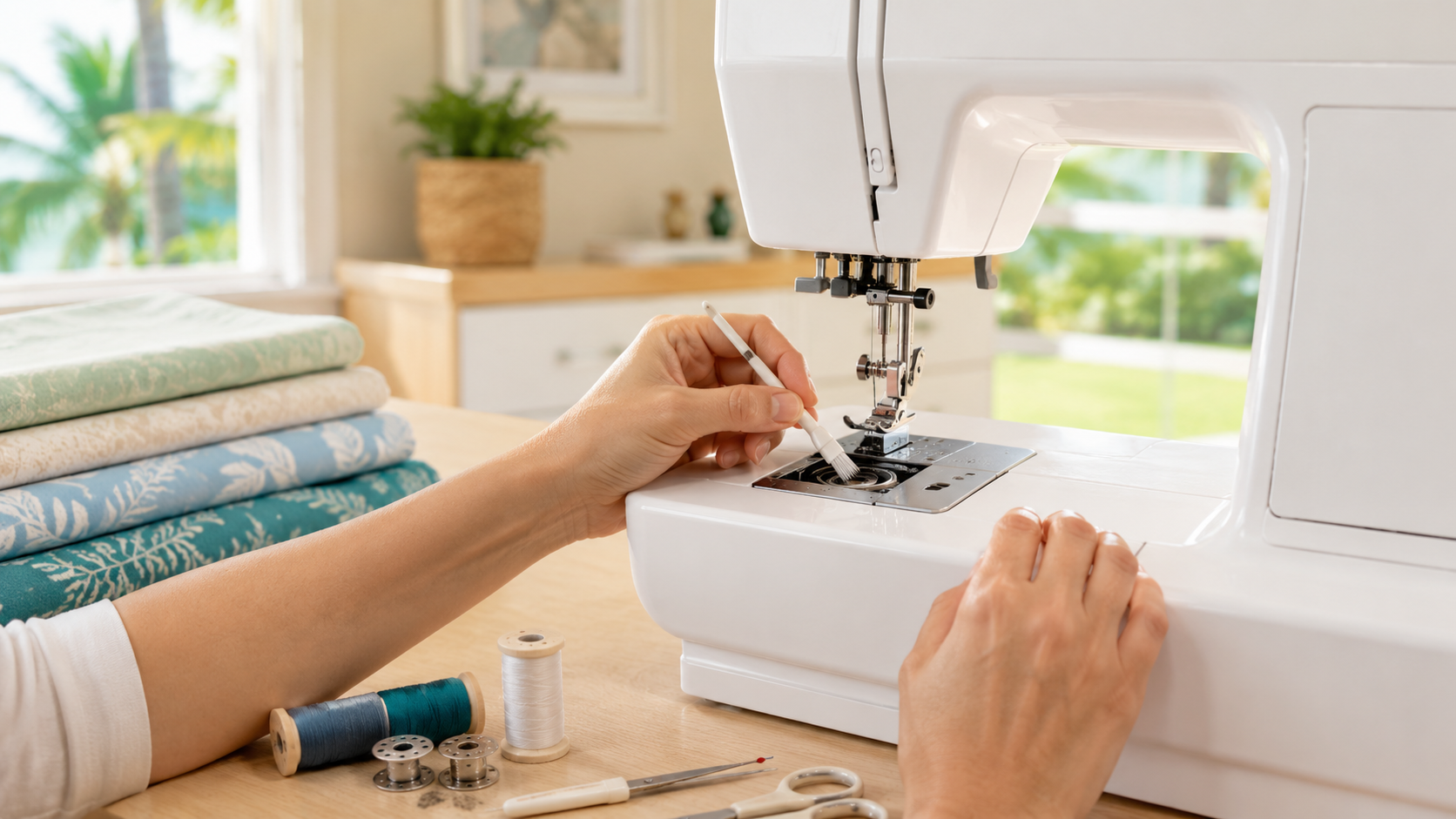
If you sew frequently, cleaning the feed-dog area should be part of your regular machine maintenance.
Turn the machine off and remove the needle plate according to your machine’s instructions. Use an appropriate cleaning brush to remove accumulated lint and debris.
Avoid forcing anything into the machine or using excessive compressed air where it could push debris deeper into the mechanism.
If the feed dogs are clean but still do not move correctly, the problem may be mechanical rather than simply a cleaning issue.
3. Your Stitch Length May Be Set Too Low
Another surprisingly common cause is an incorrect stitch setting.
If the stitch length is set extremely short or at zero, the machine may appear to be sewing without actually moving the fabric forward very much.
Check your stitch-length control and make sure it is set appropriately for the type of sewing you are doing.
For example, a standard medium-length stitch is often appropriate for general-purpose sewing, while heavier fabrics may require a different setting.
If changing the stitch length makes no difference and the feed dogs are not moving properly, you may have a mechanical issue.
4. The Presser Foot May Not Be Applying Enough Pressure
The presser foot works together with the feed dogs to move fabric through the machine.
The feed dogs grip the underside of the fabric while the presser foot holds the fabric against them. If the presser-foot pressure is too low, the feed dogs may have difficulty moving the material.
This can be especially noticeable with:
• Lightweight fabrics
• Slippery fabrics
• Multiple layers of fabric
• Thick materials
• Quilting projects
• Specialty fabrics
Some sewing machines allow the presser-foot pressure to be adjusted. If yours has this feature, the setting may need to be changed for the particular fabric you are sewing.
However, avoid randomly adjusting internal or mechanical settings. If the presser foot does not appear to be applying normal pressure, a technician can determine whether the issue is adjustment-related or caused by worn components.
5. Lint or Thread May Be Blocking the Mechanism
A sewing machine has many moving components underneath the needle plate and inside the machine.
A small amount of lint may not cause a noticeable problem. Over time, however, accumulated lint and thread can interfere with moving parts.
You might notice:
• Feed dogs moving unevenly
• Fabric feeding intermittently
• Stitch length becoming inconsistent
• A clicking or grinding sound
• The machine struggling to sew thicker materials
• Fabric getting stuck under the presser foot
Regular cleaning can help prevent these problems, but excessive buildup may require a morethorough cleaning and service.
6. The Feed Dogs May Be Worn or Damaged
Feed dogs are designed to grip fabric, but they are not immune to wear.
After years of use, the teeth can become worn or damaged. If the teeth have become smooth, they may no longer grip the fabric effectively.
This can make the machine seem as though it has lost its ability to feed fabric.
A damaged feed dog can also cause inconsistent stitching. You may notice that the machine feeds normally in some areas but struggles with certain fabrics or stitch lengths.
If the feed dogs are visibly damaged or unusually worn, replacement may be necessary.
7. Internal Gears Could Be Damaged
The feed dogs do not move independently. Their movement is controlled by a series of mechanical components inside the sewing machine.
Depending on the machine’s design, gears, cams, shafts, and other components work together to create the precise motion required to feed the fabric.
If an internal gear becomes damaged or worn, the machine may still run while the feed mechanism does not operate correctly.
This is one reason a sewing machine can sound perfectly normal while failing to move fabric.
A damaged gear is not usually something that can be fixed from the outside. Diagnosing the problem may require disassembly and inspection by an experienced sewing machine technician.
8. Sewing Machine Timing May Be Off
Timing is extremely important inside a sewing machine.
The needle, hook, feed dogs, and other components have to move in a precise sequence. If the timing becomes incorrect, the machine may develop several symptoms at once.
A timing problem can sometimes cause:
• Poor fabric feeding
• Skipped stitches
• Needle strikes
• Thread breaking
• Incorrect stitch formation
• Unusual noises
• Inconsistent stitch length
If your sewing machine recently jammed, hit a hard object, broke a needle, or experienced another mechanical incident and then stopped feeding fabric correctly, timing or another internal mechanical problem could be involved.
9. The Machine May Need Internal Mechanical Service
If you’ve checked the feed-dog setting, cleaned the machine, confirmed the stitch length, and checked the presser foot but the fabric still will not feed, it may be time for professional service.
Internal mechanical wear can develop gradually. Older machines may experience wear in gears, shafts, linkages, bearings, or other components that affect fabric feeding.
Sometimes the machine gives you warning signs before the problem becomes severe.
Pay attention if your machine has recently started:
• Making unusual noises
• Feeding fabric inconsistently
• Producing uneven stitches
• Running slower than normal
• Getting stuck during certain stitches
• Struggling with thicker fabrics
• Requiring you to pull the fabric through manually
These symptoms can help a sewing machine technician determine where to begin troubleshooting.
Should You Pull the Fabric Through Yourself?
It may be tempting to simply pull the fabric when the machine stops feeding.
Try not to.
Pulling fabric aggressively while the needle is engaged can place unnecessary stress on the needle, presser foot, feed mechanism, and other components. It can also contribute to needle breakage or damage to the fabric.
The sewing machine should normally control the fabric movement. Your job is primarily to guide the material—not force it through the machine.
If you consistently have to push or pull the fabric, there is likely an underlying problem that should be addressed.
When to Bring Your Sewing Machine in for Repair
A simple setting adjustment or cleaning may solve some feeding problems. But if the feed dogs are not moving, the presser foot is not applying proper pressure, or the machine is makingunusual noises, professional inspection is a better option.
This is especially true if you have an expensive sewing machine, computerized sewing machine, embroidery machine, or machine that has significant sentimental or professional value.
A technician can inspect the feed dogs, presser-foot mechanism, stitch controls, gears, timing, and other components to identify the actual cause of the problem.
Trying to disassemble a sewing machine without knowing how its internal mechanisms work can turn a relatively simple repair into a much more complicated one.
Sewing Machine Repair in Weston, FL
If your sewing machine is running but won’t feed fabric, you don’t necessarily need to replace the machine.
The problem could be something as simple as lowered feed dogs or a stitch setting. It could also be caused by lint buildup, incorrect presser-foot pressure, worn feed dogs, damaged gears, timing problems, or normal mechanical wear.
The important thing is to identify the cause before continuing to sew and potentially making the problem worse.
For homeowners and sewing enthusiasts in Weston, Florida, professional sewing machine repair can help get your machine feeding fabric smoothly again. A proper inspection can determine whether the issue is a simple adjustment, cleaning, replacement part, or more involved mechanical repair.
Common Sewing Machine Feeding Problems We Can Help Diagnose
If your machine is experiencing any of these problems, it may be time for service:
• Sewing machine runs but won’t move fabric
• Fabric barely moves while sewing
• Feed dogs aren’t moving
• Feed dogs won’t rise
• Fabric gets stuck under the presser foot
• Sewing machine stitches in place
• Stitch length is inconsistent
• Presser foot isn’t holding fabric properly
• Machine skips stitches while feeding
• Fabric bunches underneath the needle
• Machine makes unusual noises while sewing
• Feed mechanism works intermittently
Don’t assume that a sewing machine that won’t feed fabric has reached the end of its useful life. Many feeding problems are repairable, and diagnosing the problem early can help prevent additional damage.
If your sewing machine runs but your fabric isn’t moving the way it should, professional sewing machine repair in Weston can help determine what’s preventing the feed system from doing its job.
If your sewing machine still will not feed fabric after checking the feed dogs, stitch length, presser foot, and visible lint buildup, the problem may involve worn gears, timing issues, or another internal component. For local service, learn more about our sewing machine repair in Weston, FL and the types of problems our technicians can diagnose.
Different sewing machine brands can develop different feeding and mechanical issues. If you own a Singer machine that is skipping stitches, making unusual noises, or failing to move fabric properly, visit our Singer sewing machine repair page for more information about professional service and troubleshooting.
Brother sewing machines can also experience feed problems related to the presser foot, feed mechanism, stitch settings, or internal components. Owners experiencing these issues can learn more about our Brother sewing machine repair services and available diagnostic options.
If basic troubleshooting does not solve the problem, professional inspection can help identify the cause before additional wear develops. Our Weston sewing machine repair service can help determine whether your machine needs cleaning, adjustment, replacement parts, or more extensive mechanical repair.